
The short answer: be honest, then make the next step clear
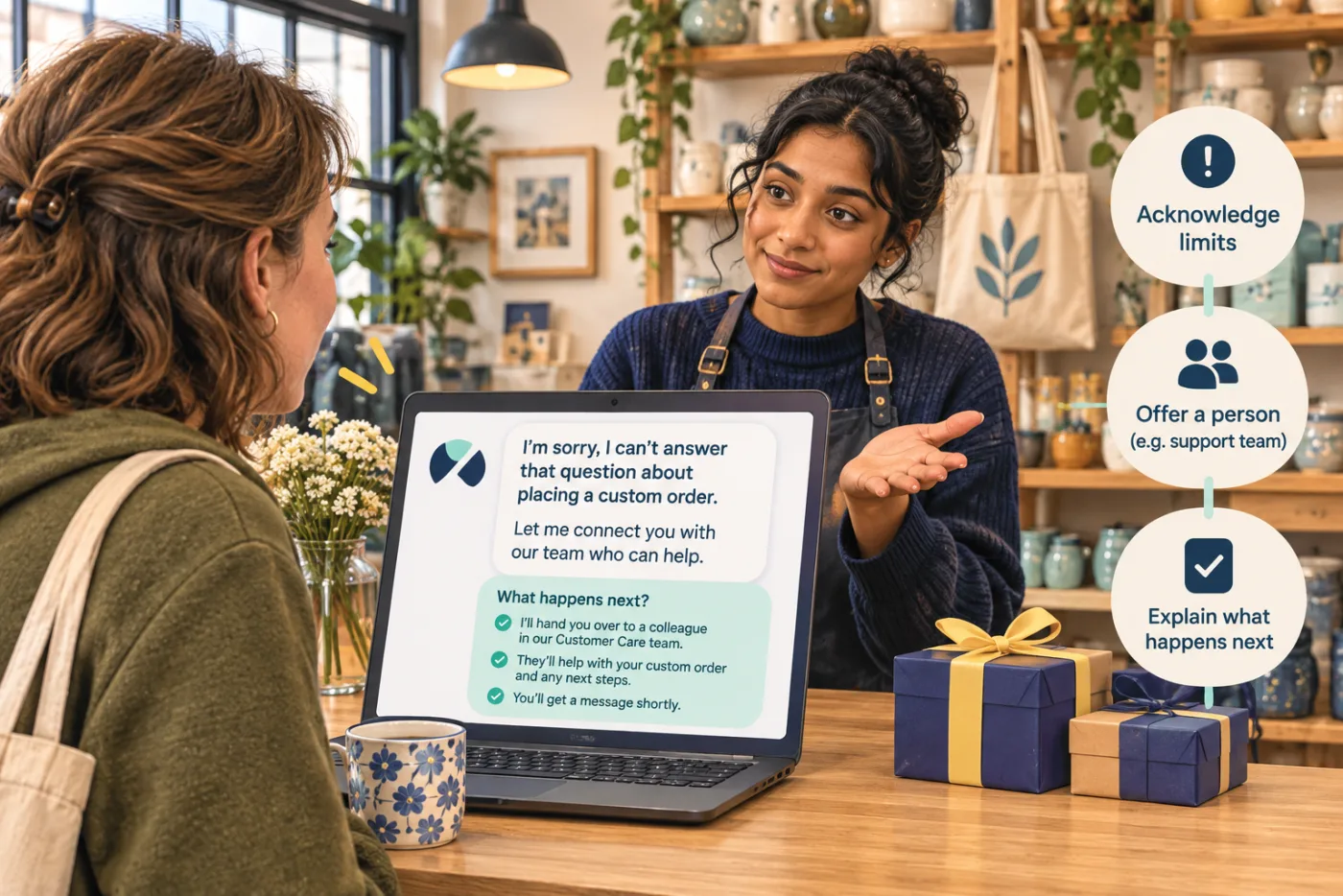
When an AI helper cannot answer from approved information, it should say so rather than guess. It should then offer an available route to a person, collect only the details needed and explain what happens next. Some questions need human judgement or safety checks even when related information is available.
This is an escalation: moving a question beyond the helper’s agreed boundaries to someone who can deal with it. A useful escalation needs a destination, an owner and a follow-up plan, not just an apology.
Be precise about the route. A live transfer connects the customer to a person during the conversation. Taking a message means someone receives the enquiry and follows up later. Do not promise either unless it has been set up and tested. If neither is available, say so and offer a supported alternative.
For urgent or safety-sensitive situations, do not rely on an unattended message queue. Explain the helper’s limits and give the route agreed for that situation, such as an available trained person or, where appropriate, an emergency service. Do not imply that a queued message will receive immediate attention.
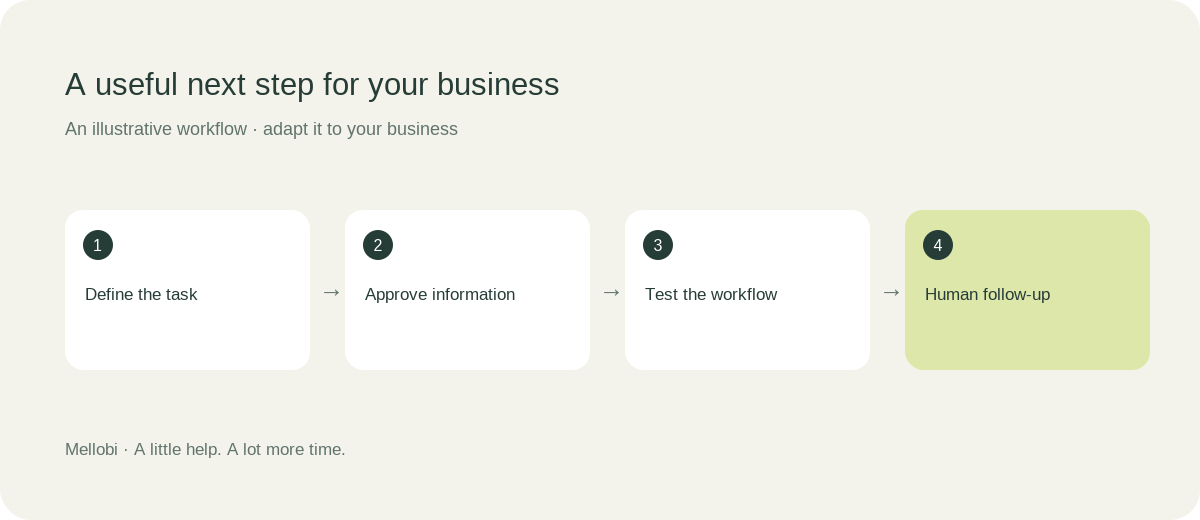
Illustrative process; agree the steps and human confirmation for your own business.
Decide which questions need a person
Start with a list of questions the helper can answer using information the business has checked and approved. Escalate when the answer is missing, unclear, conflicting, out of date or outside that information. Customers should also be able to ask for a person at any point.
Set explicit rules for complaints, disputed charges, unusual requests and decisions requiring judgement. A helper might acknowledge a complaint and collect a preferred contact method, but it should not invent a refund policy or promise an outcome. It should not create a quote or make a commitment the business has not authorised.
Safety-sensitive questions need clear boundaries. If a customer asks about an allergen, direct them to a trained staff member who can check current ingredients and preparation risks. Do not infer that a dish is safe from a generic menu. Food Standards Scotland’s allergen training covers ingredient checks, cross-contamination and staff communication.
Do not rely on a confidence score alone or mistake confident wording for accuracy. Apply the agreed source and escalation rules.
Give the customer a useful handover
Use a consistent sequence: acknowledge the question, state the limit, offer an available contact route, collect necessary details and explain the next step. On a website, illustrative wording could be:
“I can’t confirm that from the information I have. I can pass your question to the team if you leave a contact method, or you can call us during opening hours.”
Use this wording only if both options work. If the helper cannot receive messages, direct the customer to a supported channel instead. If it can take a message, explain when the team normally checks it and give a realistic response expectation.
For a voice call, keep the explanation short. Repeat essential contact details back and let the caller correct them. If a live transfer fails, say so and offer the tested alternative; do not leave the caller waiting as though someone is connected.
Publish actual opening hours, including exceptions, and update them when they change. The GOV.UK contact pattern recommends making contact channels, hours and expected response times clear. An expectation the team can meet is more useful than a callback promise it cannot keep.
Three illustrative escalation examples
These are possible processes, not customer results. Each depends on the business having the stated route and owner in place.
Trades: an incomplete repair enquiry
- Trigger: A caller asks for a repair price, but the helper lacks the information needed for an estimate.
- Reply: “I can’t give you a price from those details. I can take a brief description and your contact details for the person who prepares estimates.”
- Receiving person: The named estimator or owner, with a backup when they are away.
- Follow-up: The estimator reviews the issue and requests any further information before deciding whether to quote. No price is presented as agreed.
Café: an allergy question
- Trigger: A customer asks whether a dish is safe for a particular allergy.
- Reply: “I can’t confirm that from the menu. Please speak to a trained member of our team, who can check the ingredients and how the dish is prepared.”
- Receiving person: The trained staff member responsible for allergen queries during that shift.
- Follow-up: They check current ingredients and preparation risks before responding. If they cannot verify the information, they should say so rather than guess.
Salon: a specific appointment time
- Trigger: A customer requests a particular service and time.
- Reply: “I can take your appointment request, but the time is not booked until it is confirmed.”
- Receiving person: The named bookings lead, or an existing booking system where that route has been set up and tested.
- Follow-up: The business or its existing booking system confirms availability and the appointment. The request alone is not confirmation.
Assign ownership so enquiries do not disappear
For every escalation type, name a primary owner and a backup. Use actual names or an actively managed role in the operating plan, rather than simply writing “the team”. Decide who checks each destination, how often they check it and who contacts the customer. Make sure the backup knows when responsibility passes to them.
A concise handover should contain:
- The customer’s question and relevant context.
- Their preferred contact method and the details needed to use it.
- When the enquiry was received and any stated urgency.
- What the helper has already said or done.
- What remains unconfirmed, such as a price, appointment or promised outcome.
Avoid collecting extra detail merely because a field is available. The recipient needs enough context to follow up, not necessarily a complete conversation transcript.
Agree a simple status process: new, assigned, waiting for a reply and closed. Decide who checks unassigned enquiries and what happens if nobody accepts one. If delivery fails, define a backup destination and a customer-facing alternative. Do not tell the customer a message has been passed on if delivery cannot be confirmed.
Plan after-hours handling separately. State when the destination is next checked; do not imply continuous monitoring if that is not the case.
Set up, test and improve the process
Before connecting a call or website helper, list common questions, approved answers and exceptions. Give each answer an owner who can review it when hours, services or policies change. Agree escalation rules and destinations before customers encounter the helper.
Choose a handover method the team can monitor. Check whether the proposed tool can carry the context the recipient needs, support the intended transfer or message route and indicate a delivery failure. A contact option displayed to the customer does not, by itself, mean a handover has succeeded.
Test the process from both sides using scenarios that cover:
- An ordinary question with an approved answer.
- An unclear request and a question outside approved information.
- A customer asking for a person midway through the conversation.
- An unavailable owner and an out-of-hours enquiry.
- A failed transfer or message delivery.
- An urgent or safety-sensitive question where related information exists but human review is required.
For each test, check what the customer hears or sees, what the recipient gets, whether the backup works and whether anything was incorrectly presented as confirmed. Correct problems and repeat the test before relying on the route.
Once the process is in use, review unanswered enquiries, missed handovers and response times with the people handling them. Look for recurring gaps: an answer may need updating, a destination may not be checked often enough, or a rule may be too broad. The GOV.UK Service Manual discusses using support feedback and response data to improve a service.
Check privacy and connections before activation
Ask prospective providers to demonstrate uncertainty handling, requests for a person, failed transfers and out-of-hours enquiries using realistic scenarios from your business. See both the customer experience and the information the recipient receives.
Check what information is collected and shared, who can access it, where it is stored, how long it is kept and how it can be deleted. Avoid requesting sensitive details unless genuinely needed, and review the privacy responsibilities relevant to your circumstances.
Ask whether calls are recorded or transcribed, which settings the business can change and what happens by default. Establish what notices customers receive, who provides them, who can access recordings or transcripts and how they are retained or deleted. Ask whether customer conversations are used to train or improve models, whether that use can be restricted, and what the agreement and settings say.
These are operating checks, not assurances that a particular setup meets your obligations. Review the answers against your circumstances before activation.
Also confirm the scope and cost of a proposed connection, who maintains it, how changes are tested and what happens if an existing system is unavailable. Do not assume a booking or other connection provides live availability or confirmation. Ask what is supported and how failures are communicated.
Why Mellobi
Mellobi offers small, practical digital help for owner-run businesses, with scope, setup and ongoing care agreed before activation. Starting points include business calls and website enquiries, with more complicated requests passed to an agreed human contact. Booking requests require confirmation by the business or its existing booking system.
The team can discuss connections to existing tools and a separately scoped custom workflow; any proposed workflow needs to be agreed rather than assumed to be a live feature. To explore what a handover could look like for your business, ask for an example or contact the team.